


The Menu of Memories – Part 1: We Eat to Live. But We Remember What We Ate It For.

Today is 13 October – 79 days until Silvester (31 December), exactly eleven weeks and two days. After the language school, the telephone experiment and the decibel archive, today gets quiet. Today is about something you can't measure: what you remember when you think of food.
Two Reasons to Eat
The first reason is the obvious one: we eat to stay alive. The body needs fuel, and food delivers it. The second reason only shows up afterwards: we eat to remember – without ever planning to.
Hardly anyone remembers calories or ingredient lists. But almost everyone remembers the kitchen where it happened, the light, the people at the table and what kind of day it was. The body keeps a ledger of the food. Memory keeps a ledger of the evening.
The Most Famous Little Cake in Literature
In “In Search of Lost Time”, the French writer Marcel Proust has his narrator dip a piece of madeleine into tea – and suddenly an entire childhood is standing there again. Ever since, many people talk about the “Proust effect”: a taste or a smell opens a door you didn't know still existed.
How exactly this works in the brain, and how strong the effect is, is a matter of research – we won't claim any numbers here. This is general knowledge, not a study. But you probably know the feeling yourself.
A Scene (Made Up)
Imagine this: on a grey Tuesday, someone opens the door to a stranger's kitchen and smells something warm and fried. Suddenly he is nine years old, his shoes are still in the hallway, and somewhere someone calls: “Wash your hands!” Nobody in this scene really exists – the editorial team made it up. The feeling behind it is real all the same.
And at Our Place: the Keftedes (κεφτεδάκια)
We serve keftedes – κεφτεδάκια – made from a grandmother's recipe. A recipe from a grandmother is rarely just instructions. It is a piece of childhood that has been passed on, from kitchen to kitchen. Anyone who grew up with dishes like these tastes more in the first bite than just what is on the plate.
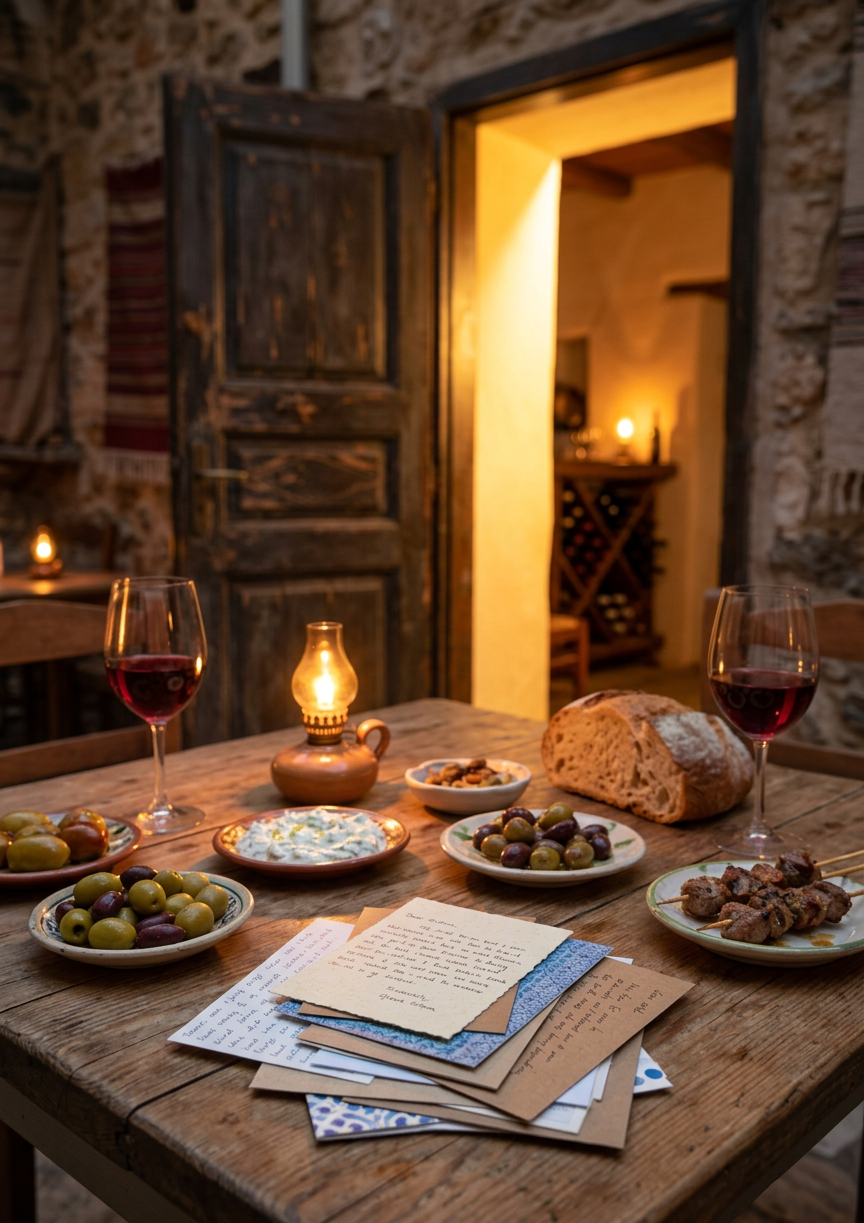
Maybe that is the real reason we go to a taverna: not only to get full, but so that the evening stays with us later as a taste.
The Menu of Memories: How to Join In
Together we are building a menu – not of dishes, but of memories. Pick one of four doors and reply with the letter and about five words:
A – Childhood kitchen: a taste from long ago.
B – Holidays: a taste from somewhere you were free.
C – Somewhere new: a taste from your first encounter with something unfamiliar.
D – Today: a taste from this week.
Examples – all made up by the editorial team, not real replies: “A – warm bread, winter kitchen, grandma, Sunday” · “B – salt on skin, grilled fish” · “C – first noodle soup in a strange city” · “D – tea, rain, Tuesday, quiet, warm”.
Reply under the comment “My five words” at the end of the article. You don't have to give a name or a place – only if you want to. We ask about taste, not about pain: if a memory is too heavy for the internet, keep it.
The Big Question: Can You Cook a Memory Again?
Team Cook-It-Again says: the recipe is the carrier of the memory. Whoever cooks remembers with their hands – and a dish you prepare again and again keeps the memory alive. Team Can't-Be-Recooked says: the kitchen, the person and a child's hunger are missing. The same plate tastes different in another time, and that is exactly why the memory stays precious. These are the arguments of the two sides, not measurements.
Where do you stand? Reply under “The big question” – one sentence is enough.
Mini-Experiment: The Memory Bite
This week, ask someone at your table: “What is the oldest taste memory you have?” Then listen to the end – without comparing, without squeezing in your own story. Give the answer time.
In Fairness
Under the last few articles it was quite quiet. That is why the bar is low this time: one letter, five words. If only a few replies come in, we'll say so honestly. If none come, in Part 2 we'll show our own – clearly marked as such – and keep the menu open until Silvester.
A transparency note: while putting Part 2 together, Claude, an AI from Anthropic, helps us by sorting the replies by theme (for example bread, sweets, grandmother, sea). The editorial team reads the result before it appears. The sorting is qualitative, not statistics. We only name names if you explicitly write that you'd like to be named.
The Roadmap to Silvester
Part 2 – “The Map of Memories” – appears on Saturday, 14 November 2026 (47 days until Silvester). In between come: Table 85, Chapter 76 (around 16 October), Language School Part 2 (Wednesday, 21 October), the Seating Usher follow-up (Friday, 23 October), Telephone Part 2 (Friday, 30 October), Language School Part 3 (Wednesday, 4 November), Decibel Archive Part 2 (Saturday, 7 November) and Resolution Swap Part 2 (Thursday, 19 November).
79 Days Until Silvester
We are still on our break until and including Thursday, 15 October, and we'll be back for you from Friday, 16 October: Mastiha Mezedopolio, Arndtstraße 12, 10965 Berlin-Kreuzberg, phone 030 612 85 386. The next Drachmen Fest comes in a year – as every year. Until then: which taste brings you home?


Comments